EN 1176 and EN 1177 Explained: Playground Safety Standards in Europe
Short answer
EN 1176 is the European standard for playground equipment. It sets the safety requirements for design, construction, installation, inspection and maintenance. EN 1177 covers the impact-absorbing surfacing underneath and around the equipment. If you're buying a playground in Europe, whether for a business, a school or a public park, these are the two standards to ask about.
What EN 1176 covers
EN 1176 is divided into several parts. Part 1 applies to all playground equipment, and the other parts add requirements for specific types of equipment:
| Part | What it covers |
|---|---|
| EN 1176-1 | General safety requirements and test methods for all playground equipment |
| EN 1176-2 | Swings |
| EN 1176-3 | Slides |
| EN 1176-4 | Cableways (zip lines) |
| EN 1176-5 | Carousels |
| EN 1176-6 | Rocking equipment (spring riders, seesaws) |
| EN 1176-7 | Guidance on installation, inspection, maintenance and operation |
| EN 1176-10 | Fully enclosed play equipment, such as indoor soft play structures |
| EN 1176-11 | Spatial networks (climbing nets) |
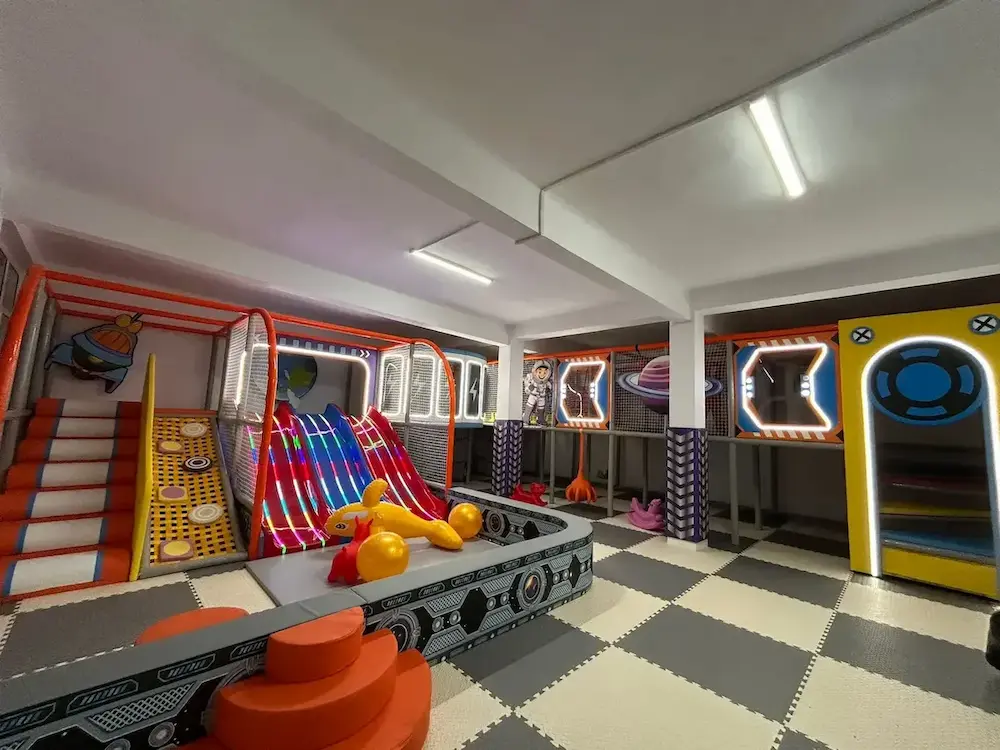
For an indoor playground, the key parts are usually EN 1176-1 and EN 1176-10. Other parts apply if the structure includes slides, swings or nets. For an outdoor playground, the parts depend on the equipment you choose.
What EN 1176 checks in practice
The standard addresses the most common causes of playground accidents:
- Entrapment: openings must not trap a child's head, neck, fingers or clothing;
- Falls: guardrails and barriers at the right heights, and safe free-fall zones;
- Impact: no sharp edges, protruding parts or hard corners in play areas;
- Structural strength: equipment must withstand the loads of many children playing at once;
- Materials: durable, non-toxic materials suitable for the environment;
- Access and supervision: especially in enclosed equipment, adults must be able to reach and see children.
EN 1177: the surface under the playground
EN 1177 defines how to test impact-absorbing surfacing and introduces the critical fall height: the maximum height from which a fall onto that surface is unlikely to cause a serious head injury. In practice:
- every piece of equipment with a free-fall height has a required impact area around it;
- the surfacing in that area, whether rubber tiles, poured rubber, sand, bark or mats, must be rated for the equipment's fall height;
- indoors, safety flooring and padding play the same role.
Who is responsible for safety?
Safety is shared across the life of the playground:
- The supplier provides equipment that complies with EN 1176, with documentation to prove it.
- The installer assembles it according to the instructions and the standard, with the right surfacing.
- The owner or operator organises regular inspections and maintenance, following EN 1176-7.
EN 1176-7 recommends three levels of inspection: routine visual checks (frequent, even daily in busy venues), operational inspections (typically every 1–3 months) and an annual main inspection by a competent person.
What documents to ask your supplier for
Before you buy, ask for:
- a declaration or certificate of conformity with EN 1176 (and EN 1177 for surfacing);
- test reports from an independent laboratory, such as TÜV;
- installation, inspection and maintenance instructions;
- the warranty terms for the structure and components.
These documents protect you if there's ever an incident, and you'll usually need them for your venue's licence or for a public tender.
How Jungle Play approaches safety
Our indoor playground equipment is produced according to EN 1176-1, EN 1176-2 and EN 1176-10, and our supplier's equipment has passed independent testing by TÜV Rheinland under EN 1176-1. Our outdoor equipment complies with EN 1176. Installation is carried out by our own team. In Romania, WNR International SRL is authorised by ISCIR for the installation, repair and maintenance of leisure equipment. With every project, we hand over the technical documentation you need.
Frequently asked questions
Is EN 1176 mandatory?
EN 1176 is a European standard. In most European countries it's the reference used by authorities, insurers and courts to judge whether a playground is safe, and many national and regional rules refer to it directly.
Does EN 1176 apply to indoor playgrounds?
Yes. Part 1 applies to all playground equipment, and Part 10 specifically covers fully enclosed play equipment such as indoor soft play structures.
How often should a playground be inspected?
EN 1176-7 recommends routine visual checks, operational inspections every 1–3 months and an annual main inspection by a competent person. Busy venues may need more frequent checks.
Need a playground that's safe and fully documented? Send us your project details and we'll prepare a tailored quote and a custom 3D design.
Request a quote →