Classic, Panoramic, Full Panoramic or Mobile: Which Padel Court Should You Choose?
Short answer
All padel courts share the same official FIP playing area of 20 × 10 m. What changes between models is how the walls are built and supported. That affects visibility, the playing experience, the installation and the budget. Classic courts are the most affordable and the most common. Panoramic and Full Panoramic courts give players and spectators a much clearer view. Mobile courts can be installed without fixed anchoring and moved later.
Here's how to choose the right one for your project.
What all padel courts have in common
Whatever the model, a professional padel court should have:
- the official FIP dimensions of 20 × 10 m;
- tempered safety glass, usually 10–12 mm thick, on the back walls;
- a steel structure protected against corrosion;
- synthetic turf designed for padel;
- LED lighting suitable for the level of play you expect.
The four types of padel court
Classic padel court
The classic court uses vertical steel posts between the glass panels, with metal mesh on the sides. It's the most widespread type, and for good reason:
- the most affordable option;
- robust and easy to maintain;
- ideal for clubs, hotels, residential complexes and private owners who want a reliable court.
The trade-off: the posts are visible from outside, so spectators get a slightly less open view.
Panoramic padel court
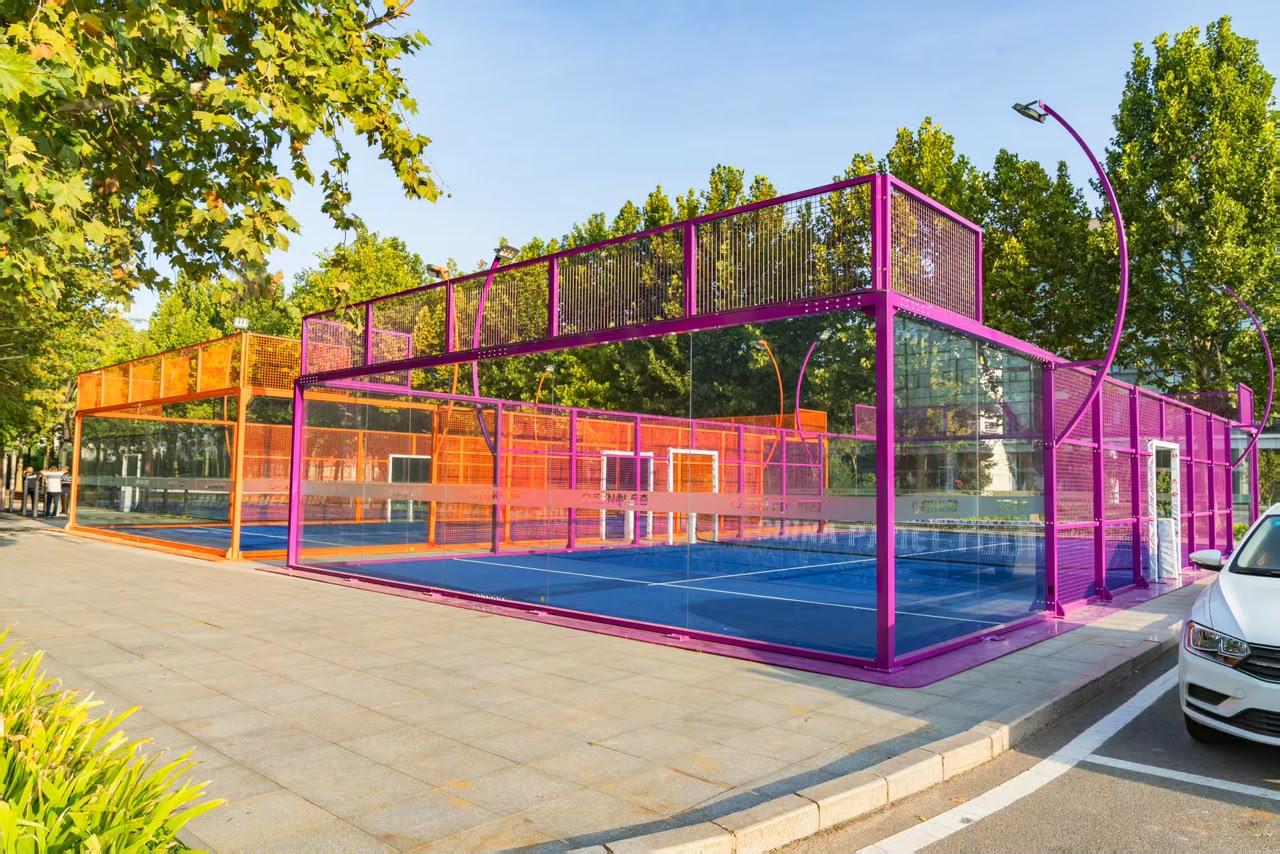
Panoramic courts reduce the structure around the glass, so the walls look almost continuous. This makes them a popular choice for:
- clubs that host tournaments or want a premium look;
- venues where spectators and visibility matter, such as hotels and sports centres.
They cost more than classic courts, but the experience for players and spectators is noticeably better.
Full Panoramic padel court
The full panoramic court goes one step further: the glass walls are supported without visible vertical posts, so the view is completely unobstructed. It's the top-of-the-range option, for:
- flagship clubs and competition venues;
- projects where image and design are a priority.
It's the most expensive model and needs very precise installation.
Mobile padel court
A mobile court is self-supporting: it doesn't need to be anchored into a concrete foundation in the same way as a fixed court. This makes it suitable for:
- temporary events and seasonal installations;
- rented land or venues where you can't do permanent works;
- businesses that may want to move the court later.
You still need a flat, stable and level surface.
Comparison at a glance
| Classic | Panoramic | Full Panoramic | Mobile | |
|---|---|---|---|---|
| Visibility | Good | Very good | Excellent | Good |
| Budget | Lowest | Medium | Highest | Medium |
| Best for | Clubs, hotels, private owners | Premium clubs, hotels | Flagship and competition venues | Events, rented land, flexible use |
| Fixed foundation | Yes | Yes | Yes | Not required in the same way |
What else to decide before choosing a model
Indoor or outdoor
For an indoor court, check the free height of the building: FIP regulations require a minimum free height of 6 m above the court, and more is better. For an outdoor court, think about wind exposure, drainage and orientation, since a north–south orientation reduces glare from the sun.
Lighting
Standard LED lighting at around 500 lux is fine for recreational play. If you plan to host official competitions, plan for 750 lux or more.
The base
A fixed court needs a flat, level concrete base with good drainage, prepared before installation. We send you the technical specifications so your local builder can prepare it correctly.
Installation time
Once the court arrives and the base is ready, on-site installation usually takes 3–5 days.
Warranty
Ask for a clear, written warranty. Our padel courts come with 10 years on the structure, 5 years on the turf and 2 years on the LED lighting.
Frequently asked questions
Which padel court type is best for a new club?
Most new clubs start with classic courts because they offer the best value. Many add one panoramic court later as a "centre court" for tournaments and events.
Can a padel court be installed indoors?
Yes, as long as the building has enough free height. FIP regulations require at least 6 m, and the floor must be flat and level.
Do I need planning permission for a padel court?
It depends on your country and municipality. Check with your local authority before you start work on the base.
Planning a padel court? Tell us where you want to build it and which model you're considering. We'll check your site and prepare a free, no-obligation quote.
Request a quote →